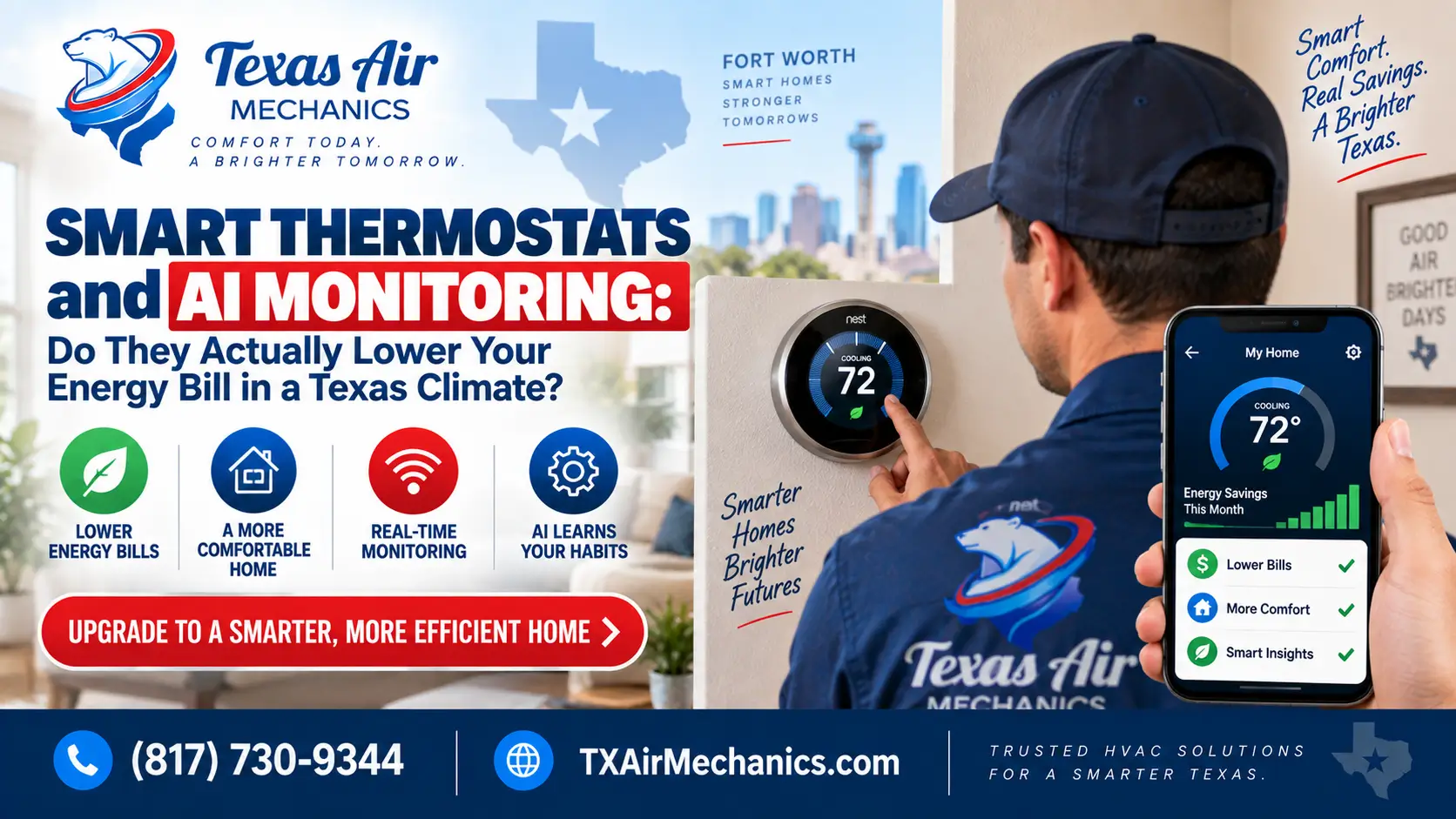
Fort Worth homeowners depend heavily on air conditioning for much of the year. When summer temperatures rise, even small changes in how long your AC runs can affect monthly electricity use.
That is why more homeowners are looking into smart thermostat energy savings in Texas. Modern thermostats can automatically adjust temperatures, learn household schedules, provide energy-use information, and let you control your HVAC system remotely.
Some newer systems also offer AI HVAC monitoring that looks for unusual operating patterns and helps homeowners identify potential comfort or equipment problems.
But do these technologies actually save money, or are they simply convenient upgrades?
Texas Air Mechanics helps homeowners throughout Fort Worth and surrounding North Texas communities understand how smart HVAC controls can improve comfort, convenience, and system management.
A traditional thermostat responds to the temperature you manually select. A smart thermostat can do much more.
Depending on the model, it may adjust operation based on schedules, occupancy patterns, outdoor conditions, or your previous temperature choices.
Common features include:
The biggest opportunity for savings comes from reducing unnecessary heating and cooling when nobody needs it.
For example, allowing the indoor temperature to rise slightly while your home is empty during a Fort Worth summer can reduce unnecessary AC runtime.
There is no single savings number that applies to every Texas home.
Smart thermostat energy savings in Texas depend on how you currently operate your HVAC system.
A smart thermostat may provide more noticeable savings if:
If you already manage your thermostat carefully, the additional energy savings may be smaller.
The thermostat does not make an inefficient HVAC system suddenly efficient. Instead, it helps reduce unnecessary runtime and gives you more control over when your system operates.
Fort Worth has a long cooling season. Air conditioning may run for many hours on extremely hot days.
This makes temperature management especially important.
Even small scheduling improvements can reduce unnecessary cooling over an entire summer.
One common mistake is setting the thermostat extremely low because the house feels hot.
Setting an AC to 65°F instead of 74°F does not normally make it cool the house faster. It simply tells the system to continue running until it reaches the lower setting.
A smart thermostat can help maintain more consistent settings without constant manual adjustment.
If everyone leaves for work or school during the day, there may be little reason to maintain the same temperature as when everyone is home.
Smart scheduling can automatically adjust the setting and return the home to a comfortable temperature before you arrive.
AI HVAC monitoring uses equipment data, thermostat information, sensors, or connected controls to identify patterns in system operation.
Instead of only controlling temperature, monitoring technology may track how the HVAC system behaves over time.
Depending on the equipment and platform, it may notice changes such as:
AI monitoring does not replace professional HVAC diagnostics, but it may provide an earlier warning that something has changed.
Remote HVAC monitoring allows homeowners or service professionals to view certain system information without physically standing in front of the equipment.
A connected thermostat is one basic form of remote monitoring.
More advanced systems can collect operating information from HVAC equipment and send alerts when performance falls outside expected conditions.
Depending on the hvac remote monitoring system, homeowners may be able to see:
This information can make it easier to notice changes before they become major comfort problems.
Remote HVAC monitoring cannot guarantee that your AC will never fail.
Components such as capacitors, motors, compressors, and electrical controls can still develop unexpected problems.
However, monitoring may help identify unusual behavior earlier.
For example, if your AC suddenly begins running much longer than usual to maintain the same temperature, something may have changed.
Possible causes include:
If a smart thermostat shows significant changes in system runtime, professional maintenance can help determine the cause.
Texas Air Mechanics offers HVAC maintenance plans for homeowners who want routine system care.
There is no single best smart thermostat for Texas heat because homes use different HVAC systems.
The right thermostat should be compatible with your equipment first.
Not every thermostat works properly with every HVAC system.
Compatibility can depend on:
High-efficiency systems may use manufacturer-specific controls to access all available features.
Some Fort Worth homes have rooms that heat up faster because of afternoon sun exposure.
Remote temperature sensors can help some smart thermostats monitor conditions in different areas of the home.
They do not repair poor insulation or duct problems, but they can provide better temperature information.
Runtime reports can help you understand how often the system operates.
If AC runtime suddenly increases even though weather conditions are similar, it may be worth having the system inspected.
Installing a smart thermostat may look simple, but HVAC wiring and system compatibility matter.
Some smart thermostats require a C-wire for continuous power. Others may need an adapter or different wiring configuration.
Incorrect installation can lead to:
Professional smart thermostat installation in Fort Worth can help ensure the thermostat communicates correctly with your HVAC equipment.
If you are also experiencing cooling problems, Texas Air Mechanics provides air conditioning repair and installation.
A smart thermostat cannot repair mechanical HVAC problems.
If your system has dirty coils, low refrigerant, restricted airflow, leaking ducts, or failing electrical components, changing the thermostat will not solve those issues.
Think of the thermostat as the control center.
It can tell the equipment what to do, but the equipment still needs to be capable of doing it efficiently.
That is why regular maintenance remains important even after installing smart controls.
Smart controls can be especially useful when paired with modern high-efficiency equipment.
Variable-speed and communicating HVAC systems can make smaller adjustments instead of operating only at full output.
This may provide:
Homeowners considering newer equipment can explore the Amana S-Series.
Smart monitoring is also useful for commercial properties.
A business with multiple HVAC systems may benefit from remote access to temperature settings, equipment alerts, and runtime information.
Commercial hvac remote monitoring can help property managers identify unusual conditions without checking every thermostat manually.
Texas Air Mechanics provides commercial HVAC services and commercial HVAC maintenance for Fort Worth businesses.
A smart thermostat may be worthwhile if you want better scheduling, remote control, energy-use information, and easier temperature management.
It may provide the most value when your current thermostat habits cause unnecessary heating or cooling.
However, homeowners should look beyond advertised savings.
Consider:
The best setup is one that works correctly with your HVAC system and is simple enough that your household will actually use its features.
Smart thermostat energy savings in Texas depend on more than installing a new device on the wall. The thermostat, HVAC equipment, airflow, home condition, and temperature settings all work together.
Texas Air Mechanics serves homeowners throughout Fort Worth and surrounding North Texas communities.
Our team can help evaluate HVAC performance, thermostat compatibility, maintenance needs, and system upgrades.
You can also check Texas Air Mechanics customer reviews on Google when choosing a local HVAC company.
Ready to improve control over your heating and cooling system? Contact Texas Air Mechanics to schedule service.
They can. Smart thermostats may reduce unnecessary HVAC runtime by adjusting temperatures when the home is empty or during scheduled periods. Actual savings depend on existing thermostat habits, weather, HVAC efficiency, and household preferences.
The best thermostat is one that is compatible with your HVAC equipment and provides the features you need, such as scheduling, remote sensors, geofencing, energy reports, and smartphone control.
AI HVAC monitoring analyzes system or thermostat data to identify operating patterns and possible changes in performance. It may provide alerts when equipment behaves differently than expected.
Remote HVAC monitoring allows certain heating and cooling information to be viewed through an internet-connected device or platform. Available information may include temperatures, runtime, humidity, settings, and equipment alerts.
It may detect unusual operation or failure to reach the thermostat setting, but it cannot always identify the exact failed component. Professional diagnosis is still needed for repairs.
A compatible thermostat installed correctly should operate safely. Problems can occur when the thermostat is incompatible, wired incorrectly, or configured improperly for the equipment.
Many do, but the thermostat must support the specific heat pump setup, including auxiliary or backup heating when applicable.
Texas Air Mechanics provides HVAC services throughout Fort Worth and nearby North Texas communities and can help evaluate thermostat compatibility and HVAC system operation.