
If you are planning to replace your heating and cooling system, you may hear contractors use terms like change-out, replacement, and new installation. These phrases sound similar, but they do not always describe the same type of project.
Understanding HVAC change out vs new installation can help you know what work is included, why prices vary, and what to expect before installation day.
A residential HVAC change out usually means removing existing equipment and installing new equipment in roughly the same location while using compatible parts of the existing setup. A new installation may require more work, such as new ductwork, electrical service, refrigerant lines, drain lines, equipment locations, or structural changes.
Texas Air Mechanics helps homeowners throughout Fort Worth and nearby North Texas communities evaluate HVAC replacement options based on the condition of the home, existing system, comfort needs, and budget.
An HVAC change out generally involves replacing existing heating and cooling equipment with new equipment while keeping much of the existing HVAC infrastructure.
For example, a homeowner may replace an older outdoor condenser and indoor coil while continuing to use existing ductwork that is still in good condition.
Depending on the system, the project may also include replacing a furnace, air handler, thermostat, drain components, or refrigerant lines.
A residential HVAC change out may include:
The exact scope depends on the existing equipment and the new system being installed.
For residential replacement services, Texas Air Mechanics provides air conditioning repair and installation.
A new HVAC installation involves adding heating and cooling equipment where there was no complete existing system or where major parts of the current setup must be redesigned.
This is common in:
A new installation may require more labor, materials, planning, and coordination than a typical change out.
The biggest difference is how much of the existing HVAC infrastructure can be reused.
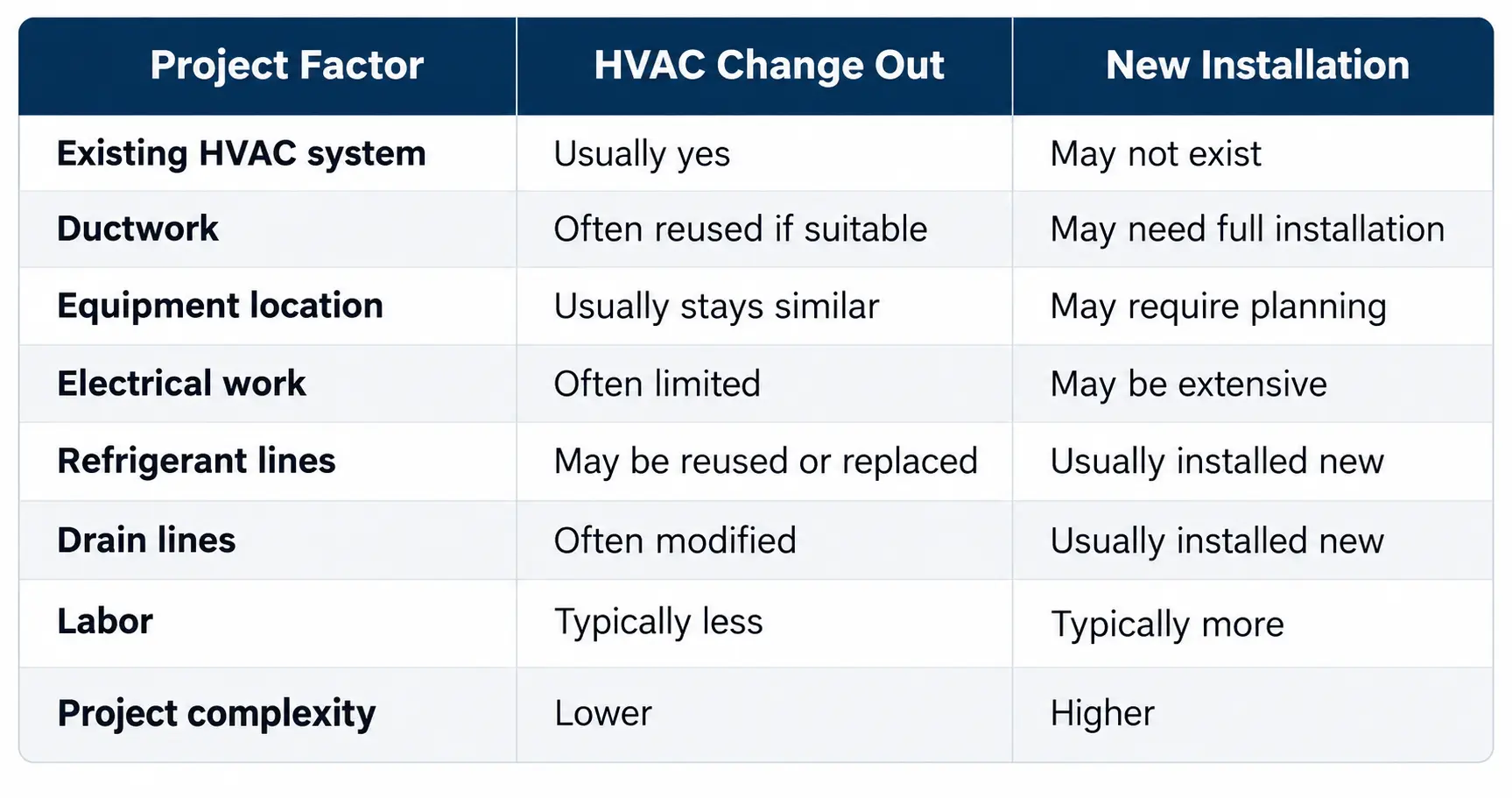
This is why two homeowners purchasing similar equipment can receive very different quotes.
The change out installation process usually begins with an evaluation of the existing system.
A contractor should not simply remove the old unit and install a new one without checking whether the rest of the system is suitable.
The technician may inspect:
The new HVAC system should match the home's cooling and heating needs.
A larger unit is not automatically better. Proper sizing helps reduce short cycling, comfort problems, and unnecessary energy use.
The old equipment is disconnected and removed.
Refrigerant must be handled correctly, and electrical and gas connections should be safely disconnected when applicable.
The replacement equipment is positioned, connected, and prepared for operation.
After installation, the technician should test airflow, refrigerant operation, electrical components, thermostat controls, drainage, and system performance.
You can view examples of completed installations on the Texas Air Mechanics our work page.
A change out can be less expensive because much of the home's existing HVAC infrastructure may already be usable.
If the ductwork, electrical setup, equipment location, and other supporting components are in good condition, the installation may require less labor and fewer materials.
However, a change out should not mean cutting corners.
If old ductwork is leaking badly or the refrigerant lines are damaged, those issues should be corrected rather than ignored to reduce the initial price.
AC change out cost in Fort Worth varies from one home to another.
The price depends on more than the outdoor unit itself.
Common cost factors include:
Because of these differences, there is no single AC change out price that applies to every Fort Worth home.
If you are comparing replacement budgets, read our guide to average air conditioning installation cost.
Replacing existing HVAC system equipment may be worth considering when repairs become frequent or the system no longer performs reliably.
Common reasons include:
If your system still operates reliably and only needs a minor repair, replacement may not be necessary.
Texas Air Mechanics can inspect the equipment and help you compare repair and replacement options.
Some homeowners expect a simple change out but discover that other HVAC components need improvement.
Old ductwork may be leaking, damaged, undersized, or poorly designed.
Installing high-efficiency equipment on poor ductwork may reduce the benefits of the new system.
Modern equipment may require electrical changes, new disconnects, or updated wiring.
Condensate drainage should be installed correctly to reduce the risk of water damage.
Sometimes the old equipment location creates service, airflow, or installation problems.
Moving equipment may increase project complexity and cost.
It depends on the age and condition of both systems.
If the furnace and AC were installed at the same time and both are aging, replacing them together may provide better equipment compatibility.
However, if the furnace is newer and in good condition, it may not always need replacement.
Homeowners can learn more about combined replacement decisions in our guide to furnace and AC replacement cost.
It can.
High-efficiency HVAC systems may require different controls, electrical components, refrigerant lines, airflow settings, or thermostats.
Some advanced systems also use variable-speed technology and communicating controls.
Homeowners interested in high-efficiency equipment can explore the Amana S-Series.
The equipment should be selected as part of the complete system rather than focusing only on the efficiency rating.
Do not compare quotes based only on the final price.
Ask what each contractor includes.
Important questions include:
A lower quote may not provide better value if important installation work is missing.
A residential HVAC change out can be a practical way to improve comfort and replace aging equipment without rebuilding the entire HVAC system.
The key is determining which existing components are still worth keeping.
Texas Air Mechanics serves homeowners throughout Fort Worth and surrounding North Texas communities with HVAC installation, replacement, maintenance, and repair.
If replacement cost is a concern, homeowners can also review HVAC financing options and available special offers.
The same general concept applies to commercial properties, although commercial systems can be more complex.
A business may replace rooftop units, packaged equipment, heat pumps, or other existing HVAC systems while reusing suitable ductwork and controls.
Texas Air Mechanics provides commercial HVAC installation and replacement for businesses planning equipment upgrades.
Understanding HVAC change out vs new installation makes it easier to compare quotes and avoid surprises.
A change out can be simpler when the existing HVAC infrastructure is in good condition. A new installation may require more work but can also provide an opportunity to correct old ductwork, electrical, airflow, or system design problems.
Texas Air Mechanics helps Fort Worth homeowners evaluate the complete system before recommending replacement.
You can learn more about Texas Air Mechanics, check Texas Air Mechanics reviews on Google, or contact Texas Air Mechanics to discuss your HVAC project.
A change out usually replaces existing HVAC equipment while reusing suitable parts of the current infrastructure. A new installation may require ductwork, electrical, drainage, refrigerant lines, and other components to be installed from the beginning.
It often can be because there may be less labor and fewer materials involved. The actual cost depends on the condition of the existing system and the equipment being installed.
AC change out cost in Fort Worth varies based on equipment size, efficiency, duct condition, electrical needs, installation complexity, and other project requirements.
Many straightforward change outs can be completed faster than full new installations, but the actual timeline depends on system complexity and whether additional repairs or modifications are needed.
Yes, if the ductwork is properly sized, sealed, and in good condition. Damaged or poorly designed ducts may need repair or replacement.
It depends on the condition, size, refrigerant requirements, and manufacturer specifications. A professional HVAC technician should evaluate the existing line set.
Not always. The decision depends on equipment age, condition, compatibility, and replacement cost. If both systems are old, replacing them together may make sense.
Texas Air Mechanics provides HVAC replacement, installation, repair, and maintenance services throughout Fort Worth and surrounding North Texas communities.