.webp)
When an air conditioner starts losing refrigerant, homeowners usually have two questions: Where is the leak, and how much will it cost to fix? The answer depends heavily on where refrigerant is escaping, how difficult the leak is to locate, what refrigerant the system uses, and whether a component can be repaired or needs replacement.
A typical freon leak repair cost can range from a relatively affordable repair at an accessible fitting to a much larger expense when the evaporator or condenser coil needs replacement. Current national pricing references put leak detection around $100 to $450, refrigerant line repairs around $200 to $1,500, evaporator coil work around $600 to $2,000, and condenser coil work around $900 to $2,400. These figures are general planning ranges, not Texas Air Mechanics prices or guaranteed local quotes.
At Texas Air Mechanics, we help homeowners throughout Fort Worth and surrounding North Texas communities determine whether low refrigerant is caused by a repairable leak, a failed coil, or a system that may no longer make financial sense to repair.
If you are asking, “how much does it cost to fix a freon leak,” there is no single flat price because refrigerant leaks can occur in very different parts of an AC system.
Here is a practical planning guide:
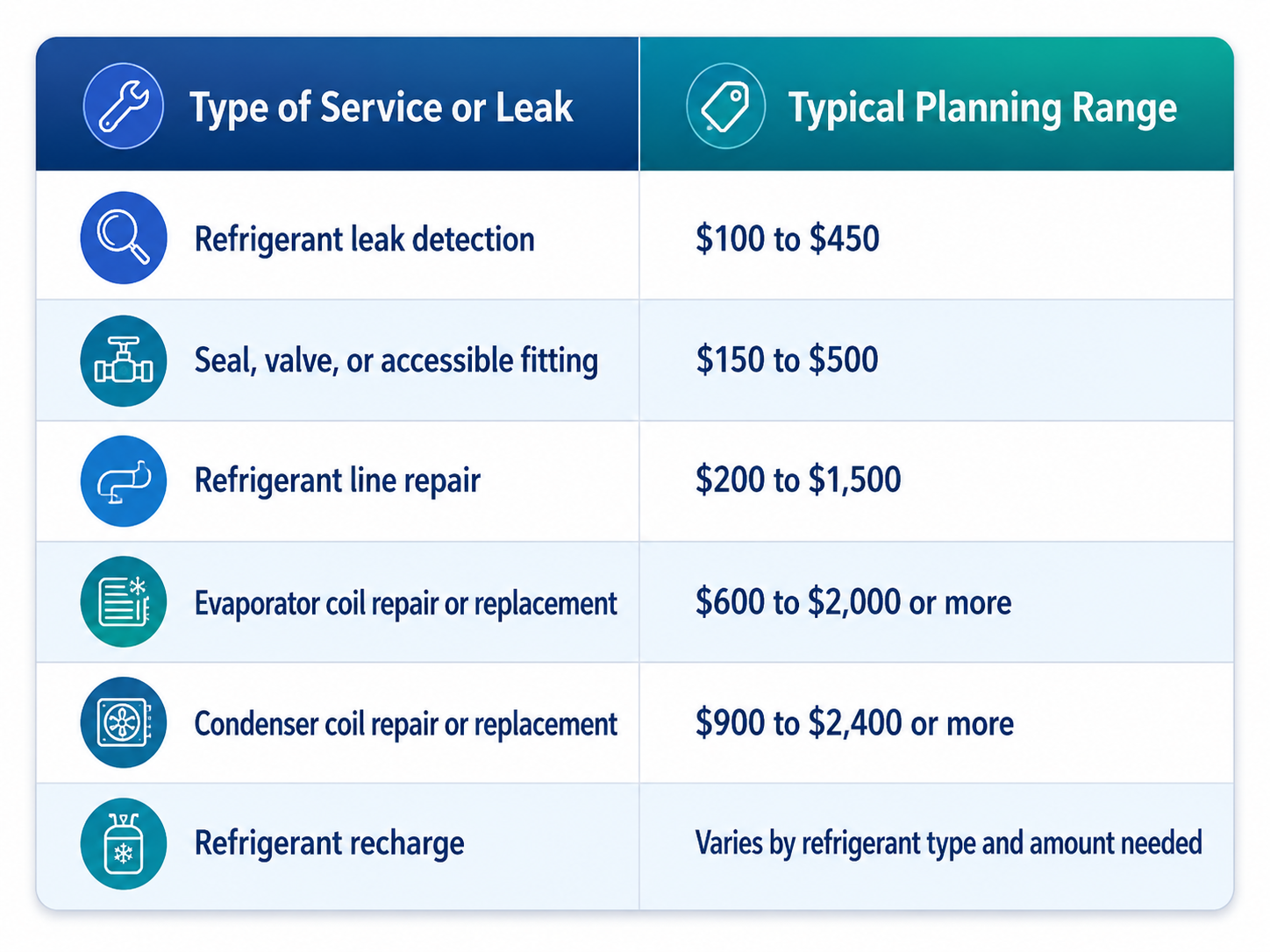
National estimates vary because labor rates, equipment design, warranty coverage, refrigerant quantity, and accessibility are different from one system to another. Some full evaporator coil replacements can exceed these ranges, particularly when the equipment is out of warranty.
The most reliable way to determine your AC freon leak repair cost is to diagnose the exact leak before discussing the final repair.
An AC leak repair cost is affected by much more than the size of the hole. A tiny leak buried deep inside an evaporator coil may cost substantially more to address than a larger leak at an accessible fitting.
Technicians have to consider where the refrigerant is escaping, whether the component can be repaired, how easily it can be reached, and how much refrigerant has already been lost.
The type and age of the equipment also matter. Parts for an older system may be harder to obtain, while warranty coverage on a newer system can change the homeowner's out-of-pocket expense.
For homeowners who already know their AC is losing refrigerant, our guide to AC refrigerant leak repair explains why repeatedly adding refrigerant without addressing the leak does not solve the underlying problem.
Before determining the cost to fix refrigerant leak in AC equipment, the technician needs to know where the refrigerant is escaping.
Depending on the system and symptoms, refrigerant leak detection may involve inspecting coils and refrigerant lines, checking joints and service valves, evaluating system pressures, and using professional leak detection equipment.
An AC leak test cost can therefore vary based on how quickly the source can be isolated. An obvious leak at a connection is different from a very slow evaporator coil leak that requires more diagnostic time.
Current national estimates generally place professional leak detection in the $100 to $450 range.
EPA guidance also recommends that homeowners work with qualified technicians who hold the appropriate Section 608 certification when refrigerant handling is involved.
Some of the more manageable leaks occur around refrigerant lines, fittings, valves, or connection points.
If a technician can reach the damaged section without removing a major component, the freon leak repair may be less expensive than a coil replacement. Current estimates place refrigerant line repair anywhere from roughly $200 to $1,500 depending on the location and amount of work required.
Longer line repairs, inaccessible piping, or damage behind walls can increase labor.
Once the leak is repaired, the technician must confirm that the system can hold pressure and then restore the proper refrigerant charge.
The indoor evaporator coil is one of the more expensive places for a refrigerant leak to develop. It sits inside or near the air handler and absorbs heat from the home's indoor air.
An evaporator coil leak repair cost depends on whether the leaking area can reasonably be repaired or whether the entire coil must be replaced.
Replacing a coil may involve opening the air handler, recovering refrigerant, removing the damaged coil, installing the replacement, reconnecting refrigerant lines, evacuating the system, and recharging it correctly.
This amount of labor explains why the AC coil leak repair cost can become significant.
National pricing data varies substantially. One current guide estimates evaporator coil repair or replacement at approximately $600 to $2,000, while complete replacement on certain systems can cost considerably more, especially outside warranty coverage.
The condenser coil is located in the outdoor AC unit. It releases the heat that your system collected from inside the home.
Because the outdoor unit is exposed to heat, weather, vibration, debris, and normal equipment wear, refrigerant leaks can eventually develop in the condenser assembly.
A condenser coil leak repair cost may fall around $900 to $2,400 in broad national estimates, depending on whether repair is possible or the coil requires replacement.
On an older system, a major condenser coil problem can also raise an important question: Is repairing this equipment still the best financial decision?
One mistake homeowners sometimes make is comparing only the freon recharge cost when they actually have a refrigerant leak.
A recharge replaces refrigerant that has escaped. It does not automatically repair the place where the refrigerant escaped.
The AC refrigerant recharge cost depends on the refrigerant type, amount required, system capacity, service labor, and current refrigerant pricing. Manufacturer guidance also notes that recharge pricing includes more than the refrigerant itself, since service and labor are part of the total expense.
This means a homeowner could pay for refrigerant today and experience the same cooling problem later if the original leak remains.
Texas Air Mechanics recommends diagnosing the reason for refrigerant loss before treating a recharge as the complete solution.
Professional air conditioner refrigerant leak repair is more than adding coolant.
Depending on the problem, service may include:
This complete process helps confirm whether the AC is ready to return to normal operation.
If the system is already running but producing little cooling, our article about an AC running but not cooling explains other issues that can create similar symptoms.
Low refrigerant can show up in several ways. Your home may take longer to cool, air from the vents may feel warmer than usual, or the system may run for extended periods.
Ice around the evaporator coil or refrigerant tubing can also be a warning sign. Some leaks produce a noticeable hissing sound, while very small leaks may show few obvious symptoms until cooling performance drops.
These symptoms do not prove that refrigerant is leaking. Airflow problems, dirty coils, thermostat issues, and compressor problems can create similar complaints.
That is why professional diagnosis should come before paying an air conditioner freon leak repair cost.
Sometimes AC refrigerant leak repair is clearly worthwhile. A newer system with a small accessible leak and healthy major components may have many useful years remaining.
The decision becomes more complicated with an older system that has a failed coil, compressor concerns, recurring refrigerant loss, or other expensive repairs.
Consider the equipment age, current energy efficiency, warranty status, repair history, major component condition, and total proposed repair cost.
If the repair is approaching a substantial portion of replacement cost, ask for both options before making the decision.
Our guide to the average cost to replace an AC unit can help homeowners understand the replacement side of that comparison.
Texas Air Mechanics also offers HVAC financing options for qualifying repairs, replacements, and upgrades.
North Texas air conditioners work through long periods of heavy cooling demand. When refrigerant loss reduces system capacity, the problem often becomes especially noticeable during hot afternoons.
Homeowners looking for AC repair in Fort Worth can contact Texas Air Mechanics for system diagnostics, cooling repair, and refrigerant-related service. The company provides residential and commercial HVAC services throughout Fort Worth and surrounding areas.
Your actual AC refrigerant leak repair cost in Fort Worth will depend on the equipment rather than a generic online average. A technician needs to determine whether the problem involves a fitting, refrigerant line, evaporator coil, condenser coil, or another component.
If you need HVAC service in Bedford, a proper leak diagnosis can help prevent unnecessary refrigerant charges or parts replacement.
Homeowners searching for AC refrigerant leak repair in Bedford TX should pay attention to recurring low refrigerant symptoms. If a system has already been recharged and cooling performance drops again, further leak testing may be appropriate.
Texas Air Mechanics lists Bedford among the North Texas communities it serves.
Texas Air Mechanics also provides HVAC service in Euless.
For homeowners searching for AC refrigerant leak repair service in Euless TX, the best starting point is accurate diagnosis. Repair recommendations should be based on the actual leak location, system condition, and long-term value of the repair.
This is especially important when a coil replacement and refrigerant recharge could make the total repair cost substantial. Texas Air Mechanics includes Euless within its service area.
Routine maintenance cannot guarantee that a refrigerant leak will never occur, but regular inspections can reveal cooling problems and equipment wear before they become larger surprises.
Maintenance also helps address dirty coils, restricted airflow, electrical concerns, and other conditions that can make an AC perform poorly even when the refrigerant charge is correct.
Texas Air Mechanics offers HVAC maintenance plans that include checks of major HVAC components and seasonal system performance.
Texas Air Mechanics is locally owned and serves homeowners and businesses across Fort Worth and surrounding North Texas communities. The company states that it has more than 30 years of experience and is licensed and insured.
You can also see customer feedback through the Texas Air Mechanics Google Business Profile.
Rather than assuming every low-refrigerant complaint needs the same repair, the goal is to identify what is actually wrong and explain the options clearly.
For residential cooling diagnostics, explore air conditioning repair and installation. If you are ready to have your system inspected, contact Texas Air Mechanics to request service.
Current customers and new homeowners can also check available HVAC special offers before scheduling.
The cost depends on where the refrigerant is leaking. An accessible valve or line repair may be relatively inexpensive, while an evaporator or condenser coil replacement can cost well over $1,000. Leak detection, replacement parts, labor, and refrigerant all influence the total.
There is no dependable single average for every system. Current national cost guides show that minor repairs may stay within a few hundred dollars, while coil-related repairs can reach $2,000 or more depending on the equipment and warranty.
Not always. Leak detection, physical repair, refrigerant recovery, and recharge may be separate parts of an estimate. Ask what is included before approving service.
Leak location is one of the biggest factors. System age, refrigerant type, accessibility, replacement parts, labor, warranty coverage, and how much refrigerant was lost also affect the final price.
Current national estimates generally place an AC leak test cost around $100 to $450. Difficult or intermittent leaks can require additional diagnostic work.
It can be, especially on a newer system with warranty coverage. On an older unit with several major problems, comparing the evaporator coil leak repair cost with replacement can be more sensible.
A recharge can initially cost less than major component repair, but it does not remove the underlying leak. If refrigerant continues escaping, the system may lose cooling again.
Refrigerant handling requires specialized knowledge and federally required technician certification. EPA guidance recommends using properly certified HVAC technicians for air-conditioning refrigerant work.
The best way to get an accurate price is to have the system inspected and the leak identified. Texas Air Mechanics provides AC diagnostics and repair throughout Fort Worth, Bedford, Euless, and nearby North Texas communities. Visit the Texas Air Mechanics FAQ for additional HVAC questions or schedule an inspection for a system-specific quote.