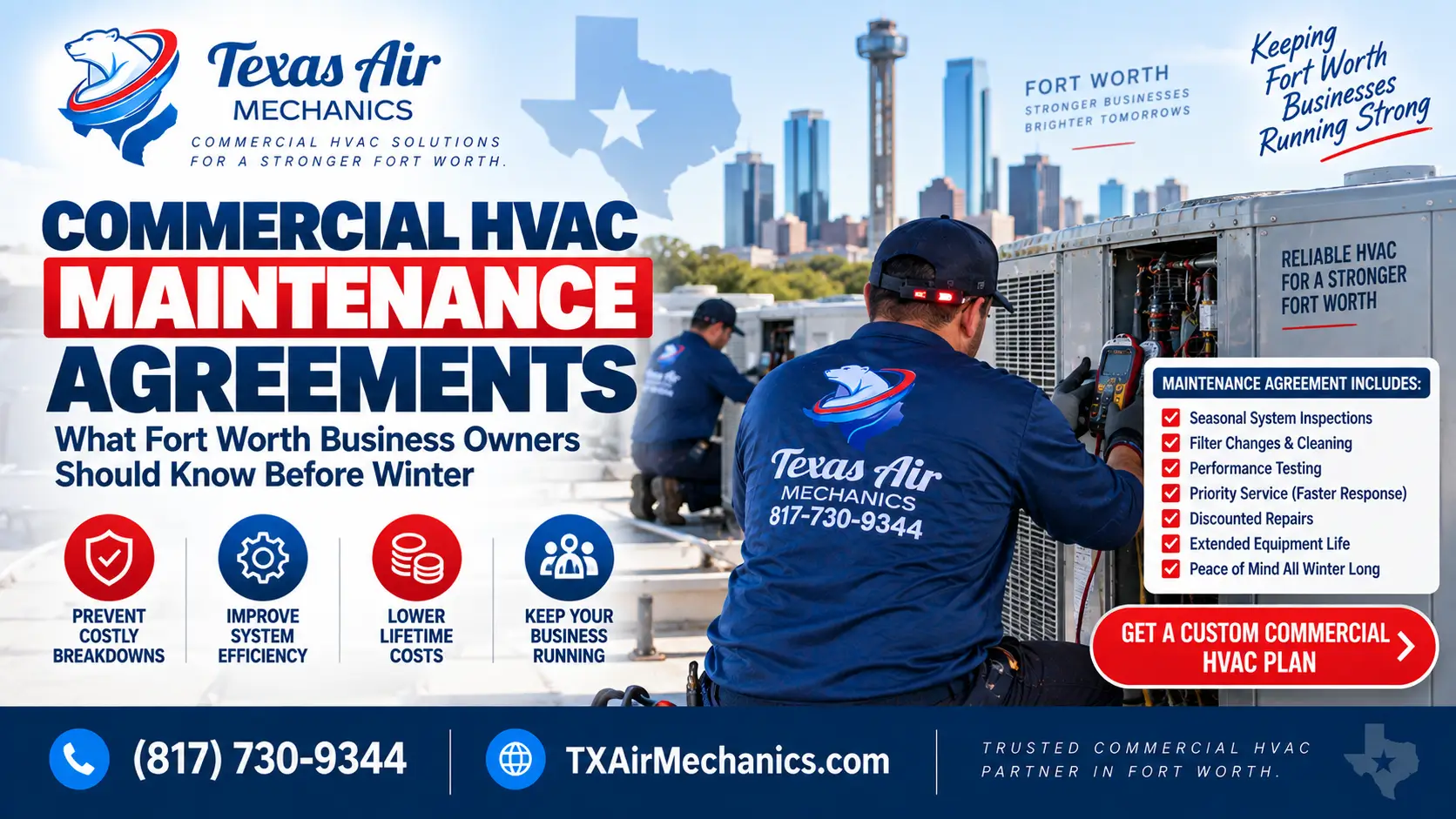
Heating and cooling problems can quickly disrupt a business. Employees become uncomfortable, customers notice indoor temperature problems, and equipment failures may interrupt normal operations.
A commercial HVAC maintenance agreement in Fort Worth can help business owners stay ahead of those problems by scheduling regular inspections and preventive service instead of waiting for a breakdown.
Texas Air Mechanics provides commercial HVAC services for businesses throughout Fort Worth and surrounding North Texas communities. A planned maintenance approach can help identify developing issues, improve system reliability, and make seasonal HVAC care easier to manage.
A commercial HVAC maintenance agreement is a scheduled service arrangement between a business and an HVAC company.
Instead of calling only when equipment fails, the property receives routine inspections and maintenance at planned intervals.
A maintenance agreement may cover rooftop units, split systems, heat pumps, furnaces, packaged systems, thermostats, and other commercial HVAC equipment.
The exact service included depends on the property and agreement.
Texas Air Mechanics provides commercial HVAC maintenance for businesses that want a more proactive approach to equipment care.
Commercial systems often run longer hours than residential equipment.
Retail stores, offices, restaurants, warehouses, and other businesses may rely on heating and cooling throughout most of the day.
Commercial HVAC preventative maintenance helps technicians identify issues before they cause a complete system shutdown.
Potential benefits include:
Preventive maintenance cannot stop every equipment failure, but it can reduce avoidable problems caused by neglected components.
A commercial HVAC inspection should evaluate the overall condition and operation of the system.
The exact checklist varies depending on equipment type.
Dirty filters can restrict airflow and make equipment work harder.
During a business HVAC tune up, filters should be checked and replaced when needed. Technicians may also inspect supply and return airflow for obvious restrictions.
Commercial HVAC systems depend on contactors, capacitors, motors, wiring, controls, and electrical connections.
Loose or worn electrical components can lead to poor performance or sudden equipment failure.
Evaporator and condenser coils should be inspected for dirt and buildup.
Dirty coils may reduce heat transfer and make the equipment run longer.
For applicable cooling and heat pump systems, technicians may evaluate refrigerant performance and look for signs that could indicate a leak or system problem.
Thermostats, building controls, and system settings should respond correctly to heating and cooling demands.
Problems with controls can sometimes look like mechanical HVAC failures.
The recommended frequency for commercial HVAC inspections depends on system use, equipment type, building conditions, and business needs.
For many commercial properties, inspections twice per year provide a practical starting point.
One visit can prepare cooling equipment for summer, while another prepares heating equipment for winter.
Some businesses may need quarterly or more frequent maintenance.
This can include properties with:
The right maintenance schedule should reflect how heavily the equipment is used rather than applying the same plan to every building.
Fort Worth winters are generally shorter than summers, but sudden cold weather can still place heavy demand on commercial heating systems.
A pre-winter commercial HVAC inspection gives business owners time to address problems before the heating system is needed every day.
A furnace or heat pump may receive little heating demand during warmer months.
When temperatures suddenly fall, worn ignition parts, electrical problems, dirty filters, or control issues may appear.
Scheduled service gives businesses more control.
If a technician finds a worn component during maintenance, repairs can often be planned instead of handled during a heating emergency.
Businesses needing heating equipment support can explore Texas Air Mechanics commercial furnace installation services.
Commercial HVAC service contract cost varies because commercial properties can be very different.
A small office with one system will have different maintenance needs than a large retail building with several rooftop units.
Pricing may depend on:
Because of these variables, there is no single price that applies to every commercial maintenance agreement.
Commercial HVAC preventive maintenance cost is often influenced by the amount of technician time and the complexity of the systems being serviced.
A building with several rooftop units requires more inspection time than a property with one HVAC system.
Older systems may need more attention because components are more likely to show wear.
A quarterly maintenance plan will generally involve more annual service visits than a twice-yearly schedule.
Rooftop systems or equipment in difficult locations may require additional service time.
Business owners should compare what is actually included rather than choosing an agreement based only on the lowest price.
Preventative maintenance commercial HVAC in Texas is especially important because equipment experiences long cooling seasons and demanding summer conditions.
Fort Worth businesses may run air conditioning for many months each year.
That heavy workload can place stress on:
Regular inspections can help identify wear before peak heating or cooling demand.
Routine service cannot guarantee that equipment will never fail.
However, many breakdowns develop gradually.
A weak capacitor, loose electrical connection, dirty coil, worn belt, or failing motor may show warning signs during an inspection.
Finding these problems early gives business owners an opportunity to schedule repairs before the system stops completely.
When a system does fail unexpectedly, Texas Air Mechanics also provides commercial HVAC repair.
Some businesses choose to service HVAC equipment only when something breaks.
That approach may seem less expensive initially, but it can make operating costs harder to predict.
A maintenance agreement creates a regular schedule for inspecting the equipment.
This can help businesses:
For many property owners, the main value is consistency.
Maintenance can help extend useful equipment life, but it cannot restore a system that has major mechanical problems.
Replacement may become worth considering when:
Texas Air Mechanics provides commercial HVAC installation and replacement when repair is no longer the most practical option.
Before signing a maintenance agreement, understand what you are paying for.
Ask about:
A clear commercial HVAC maintenance agreement should match the equipment and operational needs of your property.
Texas Air Mechanics provides commercial HVAC services for businesses throughout Fort Worth and surrounding North Texas communities.
Services include maintenance, repair, installation, replacement, and commercial heating and cooling support.
You can also learn more about Texas Air Mechanics, view examples of our HVAC work, and check Texas Air Mechanics reviews on Google.
A commercial HVAC maintenance agreement in Fort Worth can help business owners prepare for seasonal changes instead of reacting to every equipment problem after it happens.
Regular inspections provide a better understanding of system condition and can help identify repairs before they interrupt operations.
Texas Air Mechanics serves businesses throughout Fort Worth and surrounding North Texas communities.
Ready to discuss a maintenance schedule for your property? Contact Texas Air Mechanics to schedule commercial HVAC service.
Services vary, but an agreement may include scheduled inspections, filter checks, coil inspections, electrical testing, thermostat checks, airflow evaluation, and equipment performance reviews.
Many commercial systems benefit from at least two inspections per year. High-use properties may require quarterly or more frequent service depending on operating conditions.
Commercial HVAC service contract cost depends on the number of systems, equipment type, age, maintenance frequency, access, and services included.
Preventive maintenance can help identify worn components, improve system reliability, support consistent comfort, and reduce the risk of avoidable breakdowns.
For seasonal equipment, schedule service before heavy cooling demand in spring and before heating demand in fall. High-use properties may need additional visits.
A technician may inspect filters, airflow, coils, electrical components, controls, motors, refrigerant operation, heating components, and overall system performance.
Maintenance may help catch smaller problems before they become larger failures. Actual savings depend on equipment age, condition, usage, and repair needs.
Texas Air Mechanics provides commercial HVAC maintenance, repair, installation, and replacement services for businesses throughout Fort Worth and nearby North Texas communities.